Start with what you can actually see
A Tarot image contains objects, figures, gestures, colors, and a setting. Begin by describing those details before deciding what they mean. “A figure holds a raised wand” is an observation; “I have everything under control” is an interpretation that still needs context.
This guide uses two Rider–Waite–Smith images. Other decks may replace an object or build a scene differently. The exercises below are contemporary Seeris learning prompts; Waite’s historical descriptions are cited separately so you can distinguish a visible detail from a later practical reading.
Objects: what can be used, held, or shared?
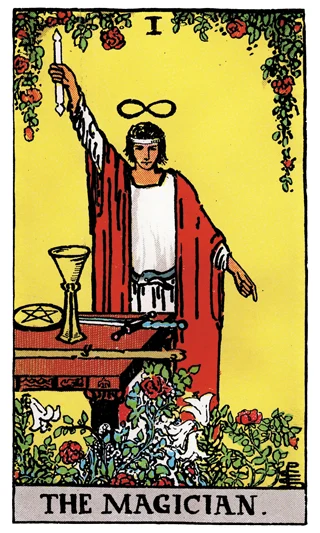
On The Magician, a cup, sword, pentacle, and wand lie on a table. Waite identifies these as the symbols of the four suits. One hand holds a separate wand up, while the other points down. Flowers frame the scene, and a horizontal figure-eight appears above the head.
For an everyday project question, you might read the tools as an invitation to identify what is available. The raised and lowered hands can prompt you to connect an intention with something you can do. These are possible connections, not evidence that a particular outcome is guaranteed.
Try a precise question: “Which resource have I not yet used?” List a skill, a conversation, a tool, or time you can realistically set aside. The four suits guide gives a vocabulary for the objects without making them interchangeable.
Paths and setting: where does the scene lead?
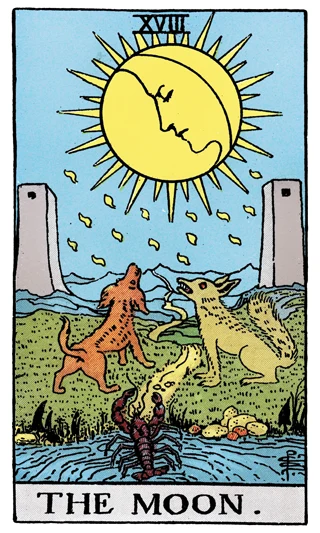
On The Moon, a path runs between two towers and continues toward the distance. A dog and a wolf stand on either side; a creature emerges from the water in the foreground. Waite describes the path as an opening into the unknown and discusses the scene through imagination and reflected light.
For a practical reflection, separate what you can see near you from what remains unclear further away. You might know that you are joining a new team but not yet understand its routines. A useful next step is asking how a meeting works, rather than assuming the image reveals what your colleagues think.
Water and light: compare their roles in the scene
Water is often used in modern readings to explore emotional experience, but its role changes across images. In The Moon, it is the foreground from which a creature emerges. On The Star, water is being poured. Describe the action before applying a general association.
Likewise, compare the Moon’s broad light with The Hermit’s lantern. A lantern held by a figure has a different job from a moon above an entire landscape. You can ask what part of the situation needs focused attention without declaring every light a promise of clarity.
Color and number can add another layer, but start with fewer details. A red garment does not prove anger, and a number does not supply a date on its own. Check the whole scene, the tradition, and the question before choosing a meaning.
A short exercise: observation, association, context
Use three lines in your Tarot journal:
- Observation: Describe one visible detail without an emotional label. For The Moon: “The path continues beyond the towers.”
- Association: Name one possible theme, such as uncertainty about a next stage. Leave room for a second interpretation.
- Context and response: Connect the theme to your question and choose something you can verify. “I do not know how the team divides tasks, so I will ask for an example.”
Then consult the card’s guide. Notice which details you missed and whether your interpretation required facts you did not have. Learning a traditional description can expand your reading without erasing your first observation.
What if the same symbol appears on different cards?
Compare how it works. Justice’s sword is held upright while The Magician’s lies on a table. One scene can emphasize deciding and accountability; the other can emphasize an available resource. The object is similar, but posture and context change the reading.
If several cards share a symbol, use the reading cards together guide to connect their positions. Avoid treating a repeated detail as automatic confirmation that an assumption is true. The goal is an interpretation you can explain and a question you can take back into everyday life.
Sources & approach
Sources for historical references and Rider–Waite–Smith symbol descriptions are linked below. The practical examples and reflection prompts are Seeris interpretations.